
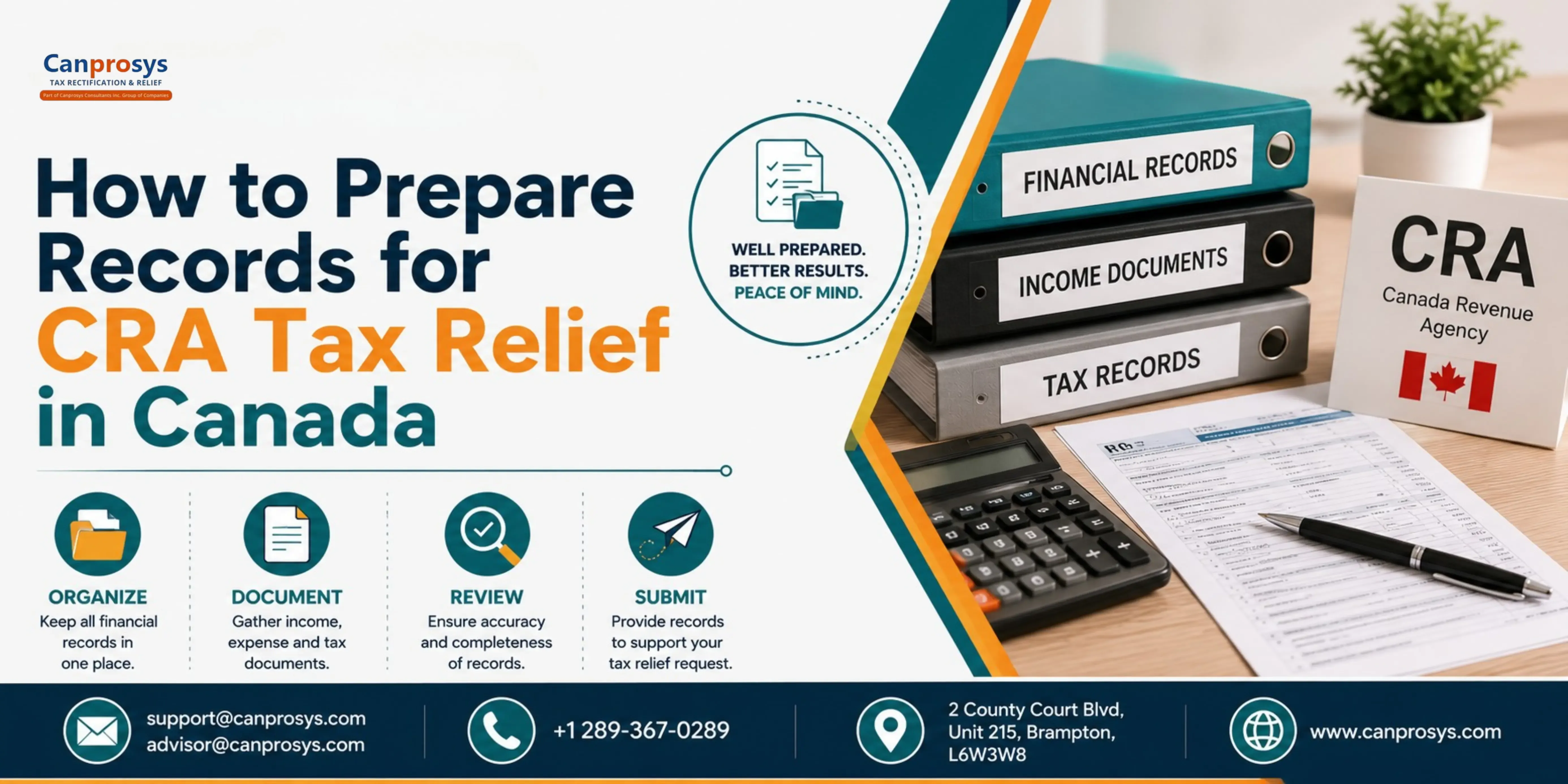
If you are dealing with tax debt, preparing the right financial documents can make a significant difference in how your case is handled. Whether you’re requesting payment arrangements, taxpayer relief, or only making a progress towards resolving outstanding balances, organized records will ensure that your financial situation is properly reflected.
Most of the Canadians are interested in CRA tax relief accounting services as their professionals are aware of the type of documents that should be provided to the Canada Revenue Agency (CRA). By pre-planning everything, it can minimize delays, enhance communication and make the process less stressful.
This guide describes the details of records you need to collect prior to the start of the tax relief process.

Why Organized Financial Records Matter
When the CRA analyses a tax relief request, they search to find that it supports your financial conditions. Failure to provide information or lacking information may slow down your application or cause more documentation to be requested.
CRA tax relief accounting services should result in a well-arranged presentation of financial information indicating the true financial status of individuals. Effective documentation will allow the professionals to see your income, expenses, assets, and liabilities and will suggest the most appropriate course of action.
The more precise your records are, the less difficulty you are going to explain your situation.
Start with Your Tax Returns
Your previous tax returns provide the foundation for almost every tax relief discussion.
Collect:
- Copies of filed tax returns
- Notices of Assessment
- Notices of Reassessment
- Statements of Account
- Outstanding balance summaries
- Any CRA correspondence
Professionals offering CRA tax relief accounting services usually review several years of tax filings to identify if there are discrepancies, unclaimed deductions, gaps in filing, or balances due that may require attention.
These records are essential because they allow saving considerable time when assessing.
Gather Proof of Income
Income documentation assists in setting up your present financial ability.
Prepare copies of:
- Employment income slips
- T4 slips
- Self-employment income records
- Pension income
- Investment income
- Rental income
- Government benefits
- Business income statements
CRA tax relief accounting services use income records when evaluating your case, and advises you on some realistic repayment options that would be affordable to you given your financial situation.
Proper reporting on income also avoids needless queries in the future.
Organize Monthly Expense Records
Your monthly expenses help explain why paying your full tax balance may be difficult.
Collect documents showing:
- Rent or mortgage payments
- Utilities
- Groceries
- Transportation costs
- Insurance premiums
- Medical expenses
- Childcare costs
- Loan payments
- Credit card obligations
Before entering into a discussion of the options, professionals who offer CRA tax relief accounting services compare your expenses with income to compose a more realistic financial picture
Having expenses well organized is also an indication of responsible financial management.
Prepare Banking Information
Recent bank account documentation gives you an idea of your financial transactions.
Include:
- Personal bank statements
- Business bank statements (if applicable)
- Savings account records
- Investment account summaries
Most CRA tax relief accounting services demand a few months of statements to verify income deposits, recurring expenses, and available financial resources.
Avoid removing transactions unless specifically advised by your advisor.
List Your Assets
In a review of some relief requests, the CRA might also take into consideration the available assets.
Prepare documentation for:
- Home ownership
- Vehicles
- Investments
- RRSPs
- TFSAs
- Business assets
- Real estate
- Valuable personal property
Experienced CRA tax relief accounting services review such records to learn your full financial situation with which they can recommend suitable strategies.
Accurate asset reporting builds credibility throughout the review process.
Record Outstanding Debts
Your overall debt obligations are one of the factors to consider when assessing affordability.
Gather statements for:
- Mortgages
- Personal loans
- Credit cards
- Vehicle financing
- Student loans
- Business loans
- Lines of credit
Experts working with CRA tax relief accounting services look at these liabilities in relation to the tax debt to understand how your financial obligations affect your ability to make payments.
Providing updated balances helps create realistic repayment expectations.
Keep Business Records if You Are Self-Employed
Business owners should prepare additional documentation.
Useful records include:
- Profit and loss statements
- Balance sheets
- GST/HST filings
- Payroll records
- Business expense receipts
- Client invoices
- Accounts receivable
- Accounts payable
Many Canadian accounting firms suggest keeping the bookkeeping well organized during the year as opposed to collecting the books only when taxation concerns are experienced.
Reliable CRA tax relief accounting services can also review business records for filing accuracy before discussions begin.
Save Important CRA Correspondence
Do not ignore letters received from the CRA.
Organize copies of:
- Collection notices
- Demand letters
- Payment reminders
- Audit correspondence
- Review requests
- Previous payment arrangements
- Appeals documentation
Discussing this communication will assist CRA tax relief accounting services to know the back story behind your account and to identify the most appropriate option.
Such documentation also eliminates confusion of past agreements or deadlines.
Prepare Supporting Documents for Financial Hardship
Some tax relief requests require evidence of financial hardship.
Supporting documents may include:
- Medical bills
- Disability documentation
- Employment termination letters
- Divorce or separation documents
- Insurance claims
- Natural disaster records
- Reduced income statements
In extraordinary cases, CRA tax relief accounting services make up supporting evidence that convinces your application and gives you a complete financial picture.
Appropriate record keeping tends to provide explanations as to why taxes were outstanding to accumulate.
Review Everything Before Seeking Professional Help
Before meeting an advisor, review your records for accuracy.
Check that:
- Tax returns are complete.
- Dates are consistent.
- Income matches supporting documents.
- Expense records are organized.
- Bank statements are available.
- CRA notices are included.
- Missing years are identified.
This preparation allows CRA tax relief accounting services to create more solutions instead of searching for missing information.
Well-prepared records often lead to more productive consultations.
How Professional Guidance Can Help
Lots of taxpayers feel overwhelmed with the outstanding taxes, the interests, or collections. The skilled tax relief specialists know what documentation needs to be made and can assist to arrange the financial details prior to communication with the CRA.
Professional advisors access your documents and files, locate all the missing files, clarify your options, and prepare accurate information for CRA negotiations. Depending on your circumstances, they may also assess whether you could qualify for penalty reduction under applicable taxpayer relief provisions.
Most importantly, documents are organized so that advisors can explain your financial position in an understandable manner, and in an effective approach to solving CRA tax problems.
Conclusion
One of the best things you can do is to prepare your records ahead of time when seeking tax relief. Organized financial documents can create a perception of credibility, decrease the time spent in the processing phase and enable advisor to construct a superior case with the proper information.
At Canprosys Consultants, we offer CRA tax relief accounting services with a great deal of integrity so that you can organize your financial records, gauge the relief opportunities available, and set forth towards viable solutions to tax debt. No matter the amount you owe to the government in taxes or you are about to negotiate with CRA, we will support you through all these process with effective CRA tax relief accounting solutions.
Frequently Asked Questions (FAQs)
1. What documents are required for CRA tax relief applications?
2. Can CRA tax relief accounting services help organize my financial records?
3. How long should I keep my financial records for CRA purposes?
4. Do I need professional assistance before contacting the CRA?
5. Can incomplete records affect my CRA tax relief request?
Disclaimer:
The information published on this website, including its articles and blog posts, is intended solely for general informational purposes. It is based on the laws and regulations in effect at the time of publication, which may have changed thereafter. Nothing on this website should be considered or relied upon as legal advice. Tax laws and individual circumstances can be complex and vary from person to person, so the information provided may not be relevant to your particular situation. For advice tailored to your specific tax or legal concerns, we recommend seeking guidance from qualified lawyers and tax professionals.