
Quick Summary:
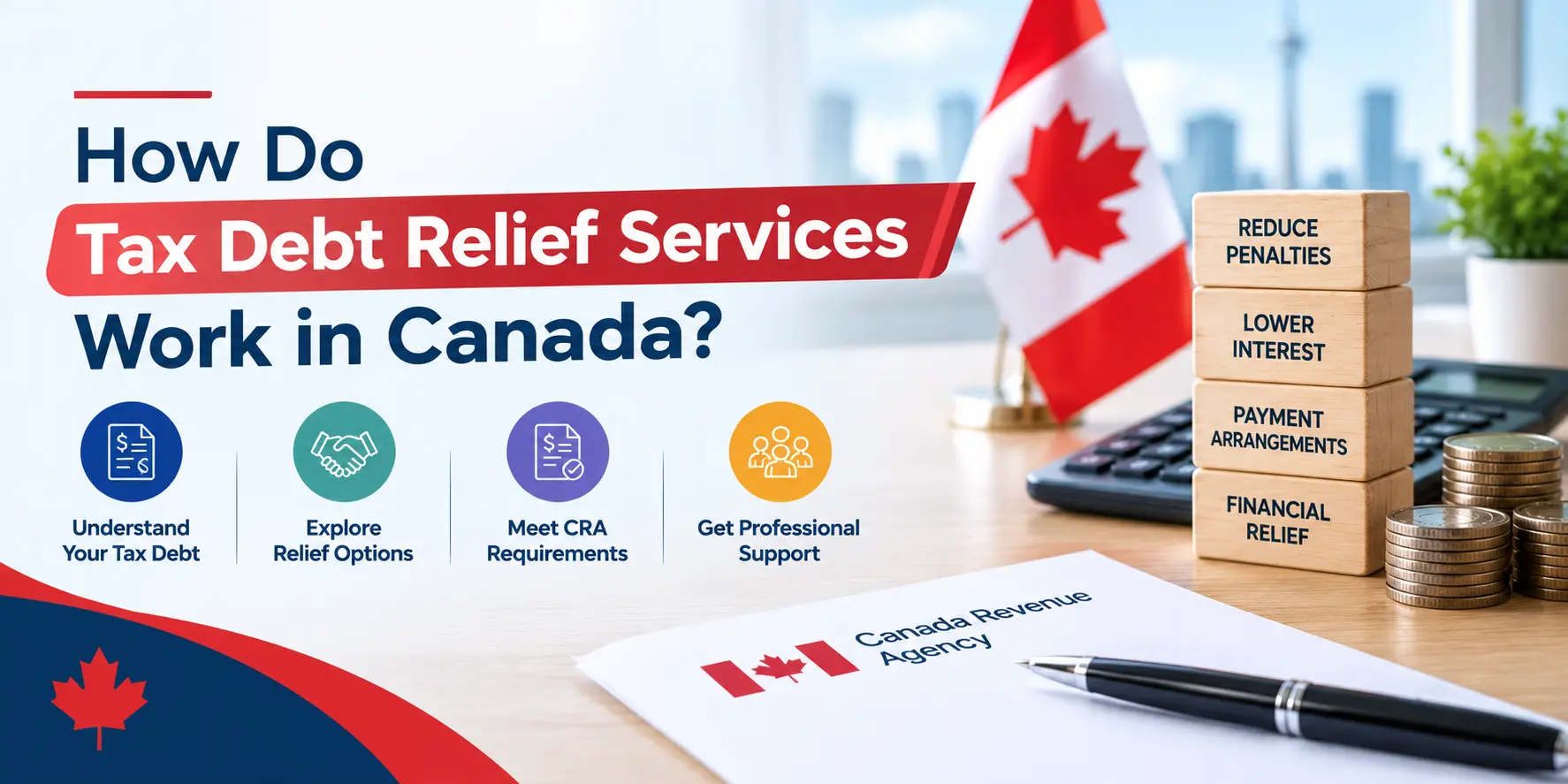
Tax debt relief services assist Canadian taxpayers in knowing and working on outstanding balances with the CRA by providing solutions to balances that may include payment arrangements, relief of interest, taxpayer relief or other CRA approved solutions. This is done by generally examining the debt, evaluating eligibility, preparing documentation, interacting with the CRA, and developing the correct resolution plan.
Introduction
Owing money to the Canada Revenue Agency (CRA) is stressful when fines, interest, collection efforts or inability to pay starts to cost your finances. Understanding how tax debt relief services can enable the taxpayers to know what can and should be done when trying to solve their CRA liabilities.
In Canada, tax debt relief does not necessarily mean that a tax balance will simply be cancelled. Relief will depend on the situation, including coming up with a payment plan, seeking taxpayer relief, dealing with penalties and interest or deciding another process under the CRA.
The initial move that individuals seeking tax debt relief Canada can make is to determine what kind of debt they want to get and which relief mechanisms may be relevant.
What Are Tax Debt Relief Services?
Tax debt relief services are professional assistance services that help individuals or businesses to comprehend and cope with outstanding tax payable to the CRA.
A professional can check the CRA account of the taxpayer, calculate the amount due, analyze their financial situation and establish possible alternatives based on CRA regulations.
Depending on the situation, assistance may include:
- Reviewing CRA notices and account information
- Assessing outstanding tax, penalties, and interest
- Preparing financial information for the CRA
- Requesting applicable taxpayer relief
- Helping establish a manageable payment arrangement
- Communicating with CRA representatives
- Explaining collection-related correspondence and requirements
The outcome will be specific to the situation of the taxpayer and which kind of relief they will be eligible to receive.
Who May Need Tax Debt Relief?
Taxpayers can seek the tax debt relief services understanding there is an outstanding balance in the CRA or they may seek help to understand their tax responsibilities.
Common situations include:
- Large outstanding income tax balances
- Unpaid GST/HST or other tax amounts
- Accumulated penalties and interest
- Temporary financial hardship
- Unexpected tax assessments
- CRA collection activity
- Difficulty negotiating a realistic payment arrangement
- Questions about eligibility for taxpayer relief
Individuals and business can face financial problems as a result of tax. Acknowledgment of a certain CRA relief measure, however, varies according to the case circumstances.
What Types of CRA Tax Debt Can Be Addressed?
There are various taxes and amounts of federal taxes that the CRA enforces. Depending on the circumstances, taxpayers may seek assistance with balances such as:
- Income tax debt: Unpaid individual or business income tax may be due to assessments, reassessments, or insufficient tax payments.
- GST/HST balances: Businesses may have unpaid GST/HST amounts resulting from filing obligations, assessments, or collection issues.
- Penalties and interest: Interest will tend to keep earning on the amounts outstanding with some penalty possibly applicable depending on the situation.
- Payroll-related amounts: Businesses with employees may face outstanding payroll remittances and related obligations.
Since various CRA debts may be subject to varying rules and collection factors, to know precisely what one owes is a significant aspect of the procedure.
What Tax Debt Relief Options Are Available?
No one will find a uniform solution to all taxpayers. Options available will determine the type of debt, financial conditions, history of compliance and applicability of CRA.
Potential options may include:
- Payment arrangements - A taxpayer, who is unable to make the balance payments right at the moment, might do so by negotiating with the CRA.
- Taxpayer relief - In qualifying circumstances, taxpayers can request relief from penalties and interest. CRA considers requests according to its administrative relief provisions.
- Financial hardship considerations - A taxpayer experiencing serious financial difficulty may have circumstances that warrant examination under applicable CRA processes.
- Account and assessment review - A review of CRA records can be beneficial to find out whether balances, filings, or assessments require clarification, or correction.
Tax debt relief services are usually meant to work out which of the legitimate options applies to the situation of the taxpayer and not that all situations qualify as the same form of relief.
How Does the CRA Tax Relief Process Work?
The procedure might vary but generally it goes through multiple steps.
Step 1: Review the CRA account - Any balances, assessments and penalties, filing history and CRA correspondence of the taxpayer are examined.
Step 2: Understand the financial situation - The income, expenses, assets, liabilities, and available cash flow might have to be reviewed, especially when seeking payment arrangements or consideration due to hardship.
Step 3: Determine applicable relief - The circumstances are compared with the CRA's requirements for available relief mechanisms.
Step 4: Prepare supporting information - Necessary forms, financial information, descriptions and documents are prepared.
Step 5: Submit the request or arrangement - The appropriate request is submitted to the CRA, or communication is undertaken regarding an applicable payment arrangement.
Step 6: Respond to CRA requirements - At any time before granting a decision or arrangement confirmation, the CRA is only likely to request further information.
Step 7: Maintain compliance - Once an arrangement or relief decision has been made, it is significant to remain up to date on subsequent tax filing and requirement.
This is among the reasons why taxpayers should seek the assistance of tax debt relief Canada professionals in cases where the CRA issue is complex.
What Documents Are Usually Required?
The precise documentation varies depending on the situation of the taxpayer and the relief requested. Typically, documents of relevancy may comprise:
- CRA notices of assessment or reassessment
- Recent tax returns and supporting schedules
- CRA account statements
- Bank statements
- Proof of income
- Employment or business income records
- Monthly household expenses
- Mortgage or rental information
- Loan and credit obligations
- Details of assets and liabilities
- Documentation supporting financial hardship, where applicable
Proper and consistent facts are significant since the CRA might analyze the capability of the taxpayer to pay based on the financial information provided.
When Should You Seek Professional Tax Debt Help?
Professional help can be considered when a CRA balance is hard to comprehend, you have begun collection, or you are not sure what type of relief could be applicable. Earlier action can also give extra time to set records straight and get familiar with processes at hand.
For individuals specifically looking for debt relief in Ontario, there is a need to deal with practitioners who comprehend the taxable demands and processes of CRA as opposed to using general debt relief options.
Canprosys Consultants works with Canadian taxpayers to address tax debt issues by understanding their situation, assisting in the organization of documents and taking them through available CRA tax relief procedures. They can assist the taxpayers to comprehend their choices more and communicate with the CRA more effectively.
Professional support does nothing to assure a reduction of a balance of tax or penalty or interest. Any relief is still open to close CRA regulations and personalized condition of the taxpayer.
Conclusion
Understanding how tax debt relief services are a difficult endeavor that can be simplified by comprehending the nature of the CRA situation. It usually begins by examining the tax debt situation and financial conditions, then determining CRA options that can be applicable, preparing documents, filing requests, and ensuring compliance in the future.
For those researching tax debt relief Canada, early choice of right information can go a long way in making clear on what might be available and what must be done.
Frequently Asked Questions
1. How do tax debt relief services work in Canada?
Tax debt relief services look into a taxpayer debt in terms of CRA debt and the financial situation and eligibility for available relief. They can aid in documentation, payment requests, request of taxpayer relief, and communication with CRA.
2. Can the CRA reduce tax debt in Canada?
The CRA might grant certain relief in qualifying circumstances, such as relief against certain penalties and interest. The qualification will be based on the relevant regulations, financial situations, and evidence.
3. What is the CRA taxpayer relief program?
The CRA taxpayer relief provisions can allow eligible taxpayers to request cancellation or waiver of penalties and interest in certain circumstances. Approval depends on the facts and supporting documentation.
4. Can I negotiate a payment arrangement with the CRA?
The taxpayers that are not in a position to pay their CRA balance at once might have an opportunity to arrange it. The CRA will take into account the financial information to judge how to effect suitable payments and collection facilities.
5. When should I get professional help with CRA tax debt?
Professional help can be useful when CRA debt is substantial, collection action has begun, financial hardship exists, or the taxpayer needs assistance understanding relief options and documentation.